News
The First AI Sports Taekwondo Poomsae Human-Machine Challenge Competition Held in Hangzhou
2026-08-22
The First AI Sports Taekwondo Poomsae Human-Machine Challenge Competition Held in Hangzhou
Envisioning the New Future of Intelligent Sports
Date: August 20, 2026 | Hangzhou, China
On August 17, 2026, the First AI Sports Taekwondo Poomsae Human-Machine Challenge Competition kicked off at the Taekwondo Training Hall of Zhejiang College of Sports. Organized by the Xihu District Competitive Martial Arts Association of Hangzhou, the event brought together more than 50 athletes competing side by side with AI robots on the same stage. An intelligent scoring system captured movement trajectories in real time, with humans and machines pitting their precision and stability against each other under the same standards.
Xie Hao, president of the association, said that this competition represents a fusion of technology and sport. It not only tests the athletes’ technique and mental fortitude, but also validates the real-world capabilities of AI systems.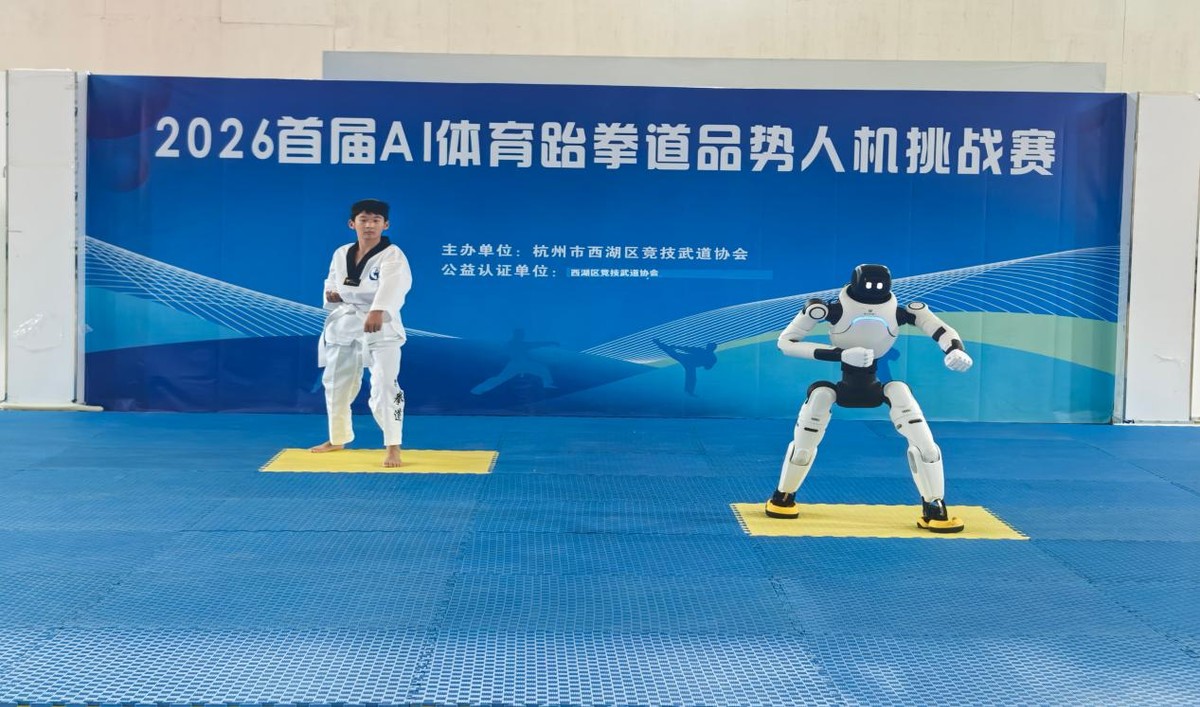
Looking ahead, the human-machine co-competition model will reshape the traditional sports ecosystem. AI robots can serve as “virtual opponents” to provide personalized sparring sessions, while intelligent analysis systems can accurately diagnose technical weaknesses and support scientific training. As motion capture and deep learning technologies continue to evolve, human-machine competition is expected to expand to more sports disciplines, promoting fairer judging, more efficient training, and more interactive spectating. This event is more than an innovative experiment — it unlocks unlimited possibilities for the future of intelligent sports.
Official Results
2026 First AI Sports Taekwondo Poomsae Human-Machine Challenge Competition
|
Event |
Team |
Athlete |
Division |
Result |
|
Taegeuk 1 Jang |
Haotian Martial Arts |
Xie Zeyu |
Children (6–12) |
1st Place |
|
Taegeuk 1Jang |
Fengyue Sports |
Zhang Shuai |
Children (6–12) |
2nd Place |
|
Taegeuk1Jang |
Zheti Yitian |
Zhu Yuhang |
Children (6–12) |
3rd Place |
|
Taegeuk 1 Jang |
Competitive Martial Arts Association |
Zhang Kexin |
Junior (13–17) |
1st Place |
|
Taegeuk 1 Jang |
Haotian Martial Arts |
Wang Ziyang |
Junior (13–17) |
2nd Place |
|
Taegeuk 1Jang |
Competitive Martial Arts Association |
Li Muxi |
Junior (13–17) |
3rd Place |
|
Taegeuk 1 Jang |
Haotian Martial Arts |
Lu Jingyi |
Youth (18+) |
1st Place |
|
Taegeuk 1Jang |
Haotian Martial Arts |
Zhang Keai |
Youth (18+) |
2nd Place |
|
Taegeuk 1Jang |
Haotian Martial Arts |
Gao Yining |
Youth (18+) |
3rd Place |
Competition Rules — 2026 First AI Sports Taekwondo Poomsae Human-Machine Challenge Competition (Taegeuk Il Jang)
The competition uses manual judging. The rules consist of two sections: Section A for the human-machine same-stage match (deduction scoring, maximum 10 points), and Section B for the detailed manual judging standards (100-point scale).
Section A — Same-Stage Match Rules (Deduction Scoring, Max 10 Points)
1. On-Stage Etiquette & Division by Age Group. The competition groups participants by age into the Children’s Division (ages 6–12), Junior Division (ages 13–17), and Youth Division (ages 18 and above). Robot programs are fine-tuned to adjust movement tempo for each division. Opening and closing ceremony etiquette: humans and robots stand at attention at the red and blue starting lines. On command, they bow to the judges’ panel, then turn to bow to each other. The athletes perform a standard bow while the robots execute their preset bowing procedures. The same ceremony is repeated at the end of the match.
2. Floor Layout & Safety Distance. Taegeuk Il Jang involves forward, backward, left, and right movements in an “I”-shaped path. The competition floor is covered with anti-slip mats arranged in a double “King”-shaped pattern, with the practice axes of humans and robots set 3.5 meters apart. Dynamic safety zone: a 1.5-meter-wide yellow warning buffer zone is established at the center between the two practice areas, ensuring there is absolutely no risk of collision when both sides perform forward thrust punches and turning movements.
3. Engineer Control & Real-Time Error Prevention. On-site engineers launch the robot programs from the sidelines, strictly synchronizing the start command with the head referee’s “Ready, Start” call. Abnormal takeover: Taegeuk Il Jang consists of 18 movements. If a robot makes a wrong turn, deviates from its route, or approaches the yellow buffer zone during the routine, the engineer must press the pause or correction key within 0.5 seconds to eliminate any hazard.
4. Emergency Power-Off & Fault Determination. Both sideline judges and engineers are equipped with power-off switches. Once triggered, the robot must power down and lock all joints within 0.5 seconds. Power-off outcome determination: if the power-off is caused by a robot malfunction, the human athlete wins outright. If the power-off results from an athlete accidentally stepping on or touching the robot’s equipment, the judges’ panel will deliberate to decide whether a rematch is granted.
5. Manual Scoring & Win/Loss Determination. The head referee and four sideline judges independently score the on-stage performance using a deduction system (maximum 10 points). Human athlete scoring focuses on: whether movements meet standard form (e.g., horse-riding stance, front kick, mid-section punch), whether power delivery shows smooth transitions between soft and hard, and whether spirit and presentation are full. Robot scoring focuses on: angle restoration accuracy, motor operation stability, and the smoothness of the 18 movements. Head-to-head result: the side with the higher total score wins. If the human athlete scores higher, the athlete goes directly on stage to receive the award. If the robot scores higher, the robot is declared the winner, and its R&D team (or the human representative of the human-machine team) accepts the award on the robot’s behalf. Tie-breaking: if the total scores are equal, the side with the higher traditional poomsae expressiveness score (spirit/smoothness) wins.
Given the format of “humans and robots competing on the same stage” with “manual judging,” these rules place special emphasis on on-stage safety and the judging standards of the human referees.
Section B — Detailed Manual Judging Standards (100-Point Scale)
6. Stage Entry/Exit & Etiquette Protocol. Joint entry: under the direction of the guide, athletes and robots step onto the floor simultaneously and stand at the red and blue starting lines respectively. Mutual respect: after bowing to the judges’ panel, human and machine turn to face each other. The athlete performs a standard bow while the robot synchronously executes its preset bowing procedure. Tribute to technology: the athlete must maintain the bowing posture until the robot completes its bowing procedure, as a sign of respect for technology and the opponent.
7. Same-Stage Safety Distance & Dynamic Boundaries. Stage separation: the floor is divided into a “Human Practice Zone” and a “Robot Practice Zone,” with a 1.5-meter-wide safety buffer zone in between. Dynamic collision prevention: both sides perform their poomsae routines simultaneously within their own zones, and neither side — including the robot’s mechanical arms — may cross the buffer zone boundary during any movement.
8. On-Site Engineer Real-Time Control. Locked-on visual tracking: the accompanying engineer’s gaze must remain locked on the robot at all times, with fingers never leaving the intervention key on the emergency control terminal. Abnormal deviation: once a robot is found to be drifting off course or approaching the buffer zone due to algorithm errors, the engineer must execute a “fine-tune correction” or “in-place hover” within 1 second.
9. Emergency Power-Off Protection. Emergency stop button: in addition to the engineer’s remote control, a physical master power-off switch is placed on the table of the sideline judges (human referees). Loss-of-control determination: once a judge or engineer triggers the power-off, the robot’s joints lock instantly. If the power-off occurs after the match is more than half complete, the judges’ panel will score manually through deliberation, based on the robot’s performance before the power-off combined with fault deductions.
10. Manual Scoring Standard (100-point scale). Athlete scoring (traditional poomsae standard): Accuracy (40 points) — movement form and center-of-gravity stability; Expressiveness (60 points) — speed and power, breathing coordination, and martial spirit. Robot scoring (technical poomsae standard): Accuracy (40 points) — joint angle fidelity and point-to-point movement precision; Expressiveness (60 points) — movement smoothness, mechanical noise control, and beat synchronization rate. Additional same-stage points/deductions: if a robot lags behind the athlete by more than one beat due to program stutter, 0.5 points are deducted for each occurrence. If an athlete makes a movement error because of disturbance from the robot’s mechanical noise, the judges’ panel may, upon deliberation, grant one free re-performance without deduction.
Article source:https://www.toutiao.com/article/7675915336989934115/